

If you run a small or growing business, you’ve probably seen the name “GPT-6 Astra” everywhere over the last few weeks. Most of what’s being written about it falls into one of two camps: “this changes everything” or “this is overhyped.” Neither is especially useful if you’re trying to decide whether any of it matters for your actual business.
So here’s a grounded look at what OpenAI has actually announced, what’s still unverified, and — more importantly — what this category of AI (not just this one model) is likely to mean for how small businesses handle marketing, operations, and admin work over the next year.
What GPT-6 Astra Actually Is
OpenAI released GPT-6 Astra on September 3, 2026, positioning it as its most capable model to date, with OpenAI describing it as state-of-the-art on computer use, browsing, software engineering, cybersecurity, science, and professional work. The rollout started with enterprise customers in OpenAI’s Daybreak program, with broader access to ChatGPT Plus, Pro, Business, and Enterprise users following over subsequent days, alongside availability through the OpenAI API, Microsoft Azure, and Amazon Web Services.
The headline capability isn’t better conversation — it’s computer use. OpenAI is pitching Astra as able to operate a computer roughly the way a person does: watching a screen and acting across browsers, spreadsheets, websites, and desktop applications, without needing a custom integration built for each one. On one internal benchmark (OSWorld 2.0), OpenAI reported a score of 72.6%, compared to 65.7% for its previous model, GPT-5.6 Sol — a meaningful jump specifically in how well the model can carry out real, multi-step tasks on a screen rather than just answer questions about them.
It’s also worth noting: OpenAI says this is the first model to reach the “Critical” threshold for cybersecurity risk under its own internal safety framework, meaning it’s judged capable of finding and exploiting previously unknown software vulnerabilities. That’s part of why access is rolling out gradually rather than to everyone at once — and it’s a useful reminder that more capable AI comes with more serious oversight requirements, not fewer.
Why This Matters Beyond the Tech Headlines
Here’s the part that actually affects a small business: for the last few years, AI tools have mostly worked the way a very fast intern works — you ask a specific question, you get an answer, and you do the rest yourself. “Write me three Instagram captions.” “Summarize this document.” One request, one output.
What’s changing with this new generation of models is the shift from answering to completing. Instead of asking ten separate questions across an afternoon, you can increasingly hand over a full task — “research these five competitors, compare their offers, and flag the gaps” — and the tool works through the steps itself.
That doesn’t mean it replaces judgment, strategy, or the parts of a business that require actually knowing your customers. It means the research and admin layer underneath those decisions is getting faster to produce. For a small business owner juggling marketing, sales, and operations without a large team, that’s a genuinely useful shift — if you know where to actually apply it.
Where AI Agents Realistically Help Small Businesses Right Now
Based on what OpenAI and other AI labs have demonstrated so far, the practical use cases that translate well to a small business context include:
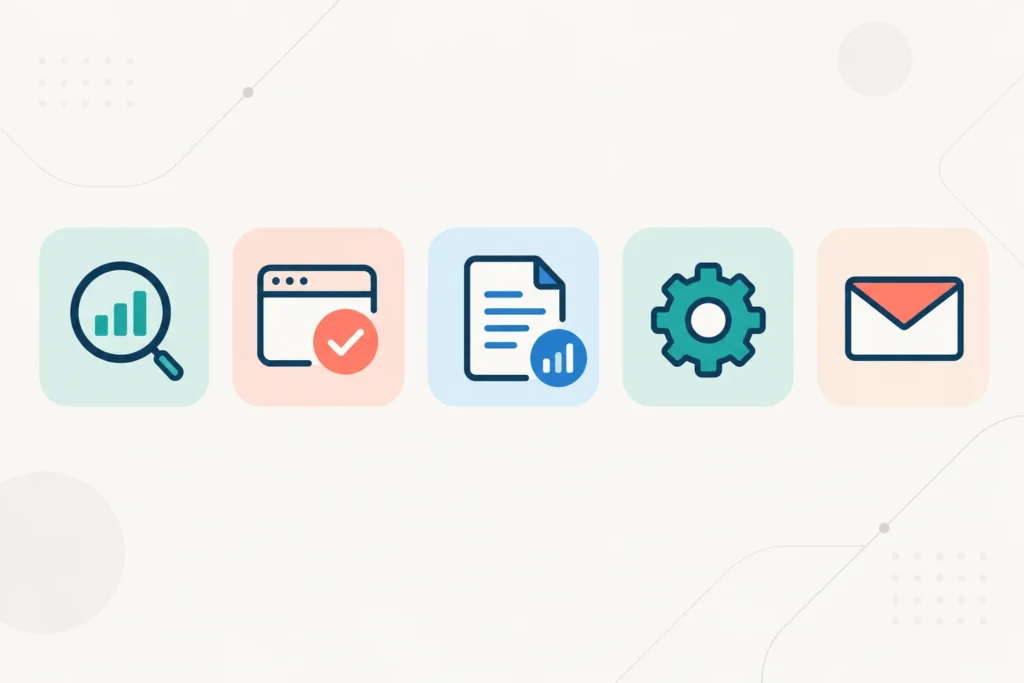
- Competitor and market research — pulling together comparisons across multiple competitor websites without manually visiting each one
- Website and content audits — flagging outdated pages, missing information, or structural SEO issues
- Reporting — turning raw analytics or sales data into a readable summary
- Repetitive admin work — form filling, structured data entry, scheduling-adjacent tasks
- First-draft content and campaign research — a starting point for content marketing and ad copy, not a finished, unreviewed product
Where Caution Still Matters
This is the part that often gets left out of AI hype cycles, so it’s worth being direct about it: “completed a task” is not the same claim as “completed a task correctly.” Independent, third-party verification of many AI capability claims — including some of Astra’s — is still limited, since most published benchmarks so far come from OpenAI itself rather than outside testing.
Practically, that means:
- Review AI-completed work before it goes anywhere client-facing or public
- Don’t hand over anything with real financial or legal consequences without a human check
- Treat early access to any new AI capability as something to pilot on a low-stakes task first, not something to route your core operations through immediately
This is true regardless of which AI company’s model you’re looking at — it’s a pattern worth applying any time a new, more capable model launches, not a criticism specific to Astra.
What This Means If You Run a Small Business
You don’t need to become an AI expert, and you don’t need to adopt every new model the week it launches. What’s worth doing is periodically asking: which one or two repetitive tasks in my business are eating the most time, and is there now a tool that can genuinely take that off my plate?
That’s a very different — and more useful — question than “should I be using GPT-6 Astra.” The specific model will keep changing every few months. The underlying shift (AI increasingly able to carry multi-step tasks, not just answer questions) is what’s actually worth building a strategy around.

Where PixWeb Fits In
At PixWeb, this is exactly the kind of shift we track for our clients — not to chase every new release, but to figure out which parts of digital marketing, ecommerce operations, and business admin are genuinely worth automating right now, versus what’s still better handled by a person. We work across SEO, paid advertising (Google and Meta Ads), social media marketing, ecommerce website development, and increasingly, AI-driven automation for the repetitive parts of running a marketing operation.
If you’ve been putting off figuring out where AI tools actually fit into your business, that’s a conversation worth having before you invest time or budget into any specific tool.
[Get in touch with PixWeb →] +91-9775515516

